SGCES - How to Choose the Right EOT Crane Capacity for Your Factory
Choosing the right EOT crane capacity is not only about the heaviest load. A good crane recommendation considers load weight, span, lift height, duty, site layout, safety margin, and future usage.
How to Choose the Right EOT Crane Capacity for Your Factory
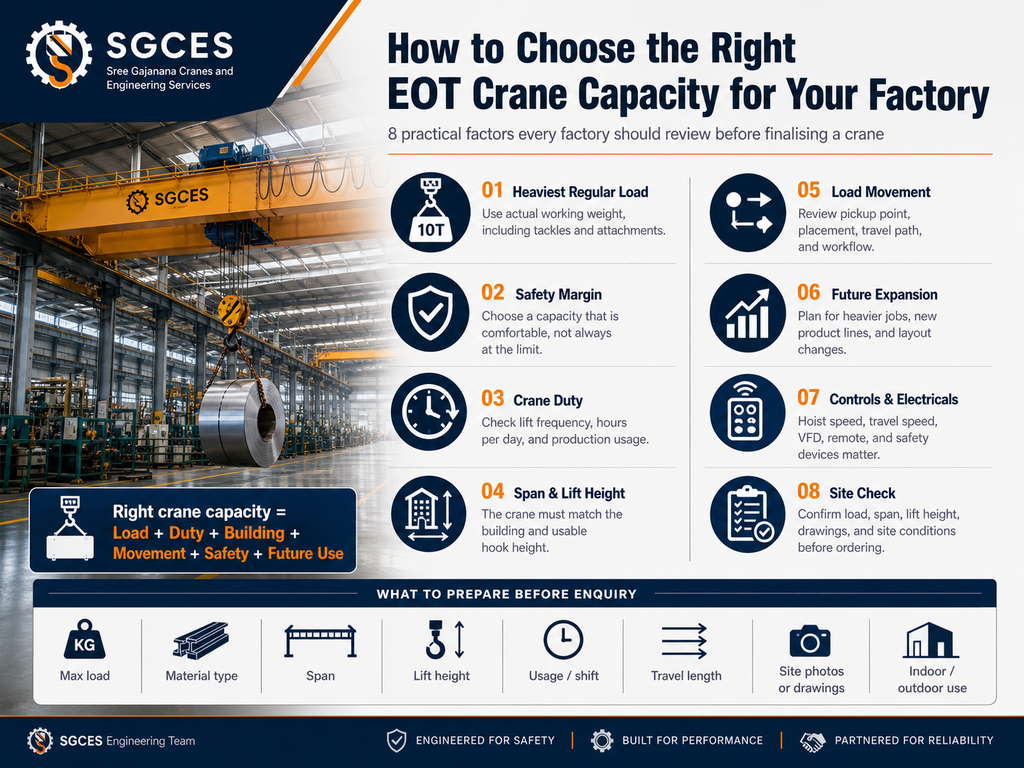
An EOT crane is a long-term shop-floor investment. If the capacity is too low, the crane becomes unsafe or unusable for future jobs. If it is much higher than required, the project may become unnecessarily expensive.
The right capacity comes from understanding the actual lifting requirement, not from guessing a number.
1. Start With the Heaviest Regular Load
First, list the heaviest item the crane will lift during normal work.
Examples:
- Fabricated steel structure
- Machine component
- Motor or gearbox assembly
- Mould, die, or fixture
- Packed dispatch material
Use the real working weight, including attachments, packing, lifting tackles, and any temporary supports.
Simple meaning:
Do not calculate only the main job weight. Include everything that hangs from the hook.
2. Add a Practical Safety Margin
A crane should not be selected exactly at the maximum expected load without review. A practical safety margin helps when the actual job weight changes, lifting tackles are added, or future jobs are slightly heavier.
For example, if the regular maximum load is close to 4.5 tons, the project team may review whether a 5-ton crane is suitable. But this should be checked with the full site and duty requirement, not only by rounding up the number.
Simple meaning:
The selected crane should be comfortable for the work, not constantly at its limit.
3. Check the Duty of the Crane
Duty means how heavily and how frequently the crane will be used.
A crane used occasionally for maintenance is different from a crane used throughout the day in production.
Important questions:
- How many lifts happen per shift?
- How many hours per day will the crane be used?
- Is the load usually light, medium, or near full capacity?
- Will the crane be used for production, maintenance, dispatch, or assembly?
Simple meaning:
Two cranes with the same capacity can still be very different if one works rarely and the other works all day.
4. Measure the Span and Lift Height
Capacity is only one part of the selection. The crane must also match the building.
Check:
- Span between runway beams
- Required hook height
- Building clear height
- Column spacing
- End approach and side approach
- Available space for maintenance access
Simple meaning:
The crane has to fit the building and still give enough usable lifting height.
5. Understand the Load Movement
A crane is selected based on how the load moves inside the factory.
Ask:
- Where is the load picked up?
- Where is it placed?
- Does it need long travel, cross travel, or only local movement?
- Are there machines, racks, columns, or work areas in the path?
- Is smooth movement important for assembly accuracy?
Simple meaning:
The crane should support the actual workflow, not only lift the load once.
6. Consider Future Expansion
Factories change. Product sizes increase. Job weights increase. New machines are added. Dispatch methods improve.
Before finalising crane capacity, review expected future needs:
- Heavier jobs planned in the next few years
- New product lines
- Larger fabrication assemblies
- Expansion of shop-floor layout
- Change from manual handling to crane-based handling
Simple meaning:
A small extra thought today can avoid another crane modification later.
7. Do Not Ignore Electrical and Control Requirements
Crane performance also depends on the control system and electrical arrangement.
Review:
- Pendant control or radio remote control
- Hoist speed
- Cross travel speed
- Long travel speed
- VFD requirements for smoother movement
- Power supply and cable arrangement
- Limit switches and safety devices
Simple meaning:
A crane is not only steel structure. Controls, motors, brakes, and safety devices matter every day.
8. Get the Site Checked Before Finalising
Before ordering an EOT crane, share site details and arrange a technical discussion.
Useful information to prepare:
- Maximum load weight
- Type of material lifted
- Span
- Lift height
- Building drawings or site photos
- Usage per shift
- Required travel length
- Indoor or outdoor use
- Existing runway beam details, if any
Final Thought
The right EOT crane capacity is a balance of load, duty, building condition, movement requirement, safety, and future use.
At SGCES, the goal is to understand the site first and then recommend a practical lifting solution for daily industrial use.
For crane, hoist, goods lift, or service requirements, contact SGCES with your load details, span, lift height, and site layout.